四、两种协作模式
4. Two patterns of collaboration
PCT申请大部分在集群内部完成。按唯一计数,五年间该集群有767件PCT申请由多名发明人共同完成,其中117件有集群外发明人参与,约占全部申请的14%。主要合作地为上海–苏州、深圳–香港–广州和北京。
Most PCT applications take place within the cluster. On a unique-count basis, over the five years, 767 of the cluster's PCT applications had multiple inventors, and 117 of these involved inventors outside the cluster, about 14% of all applications. The main collaborating locations are Shanghai–Suzhou, Shenzhen–Hong Kong–Guangzhou and Beijing.
科研活动则深度融入外部网络。按唯一计数,在60,314篇多作者科学出版物中,有42,147篇与集群外机构合作完成,约占全部科学出版物的70%。主要合作地为北京、深圳–香港–广州和上海–苏州。
Research, by contrast, is deeply embedded in external networks. On a unique-count basis, of 60,314 multi-author scientific publications, 42,147 were produced with organizations outside the cluster, about 70% of all scientific publications. The main collaborating locations are Beijing, Shenzhen–Hong Kong–Guangzhou and Shanghai–Suzhou.
五、规模与强度
5. Size and intensity
按总量计,大连位列全球第83位;按创新强度(即相对人口规模的创新产出)计,它位列第78位。
By total output, Dalian ranks 83rd in the world; by innovation intensity, meaning innovation output relative to population, it ranks 78th.
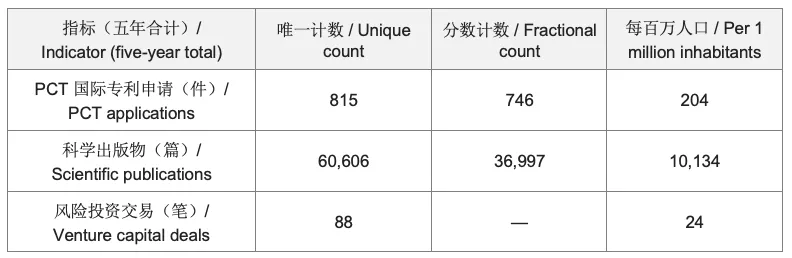
换算到人口,该集群每百万居民对应204件PCT申请、10,134篇科学出版物和24笔风险投资交易。其强度排名高于总量排名。
Per million inhabitants, the cluster records 204 PCT applications, 10,134 scientific publications and 24 venture capital deals. Its ranking by intensity is higher than its ranking by size.