01
—
Which EU Country Is the Most Expensive to Live in?
The European Union (EU) may share a currency with the euro, but the cost of living and the price of everyday items can vary a lot by country.
European statistics office Eurostat has released its report on household final consumption expenditure (HFCE) for 2025.HFCE is how much money households pay for all goods and services they use.
The Eurostat report compares how much money a country's households spend with an EU average based on the standard prices of over 2,000 goods and services.
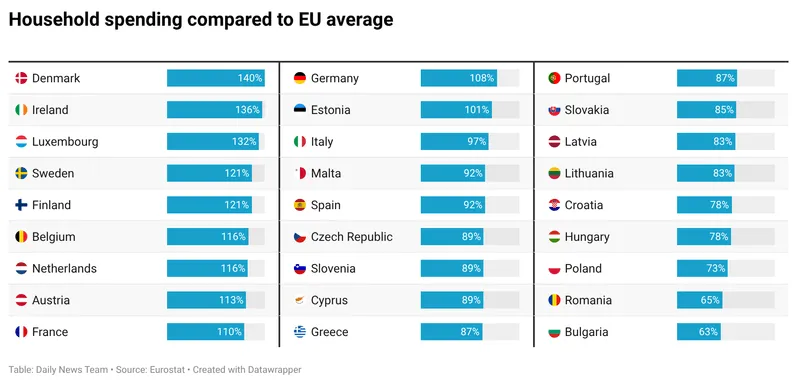
It found that the households spending the most money on goods and services in the EU were in Denmark, where HFCE was 140% of the EU average in 2025.Ireland was next at 136%, followed by Luxembourg, at 132%.
The country with the lowest HFCE was Bulgaria, at only 63% of the EU average.Romania was next at 65%, with Poland with the third lowest spending at 73%.
HFCE includes housing itself — which is what people spend more money on than anything else — and there were huge differences for this by country too.
Ireland's spending just on housing was 190% higher than the EU average.Bulgaria's spending was only 41% of the EU average.
The second biggest category was food and nonalcoholic drinks, but the variations were less dramatic here.The highest price levels were in Luxembourg at 122% of the EU average, and the lowest was 80% in Romania.
Education had the biggest differences in spending though, despite being the smallest area of expenditure at an EU level.This is perhaps because even up to university level, education is state-subsidized in most countries.
However, households in Luxembourg spent 334% of the EU average on education in 2025, while Romania spent just 42%.
The report only looked at spending and prices though, not how wages compare to it.So if a country has high average wages, a higher HFCE doesn't mean it's not affordable for residents.
The European Union (EU) may share a currency with the euro, but the cost of living and the price of everyday items can vary a lot by country.
欧盟各国虽然都使用欧元这种货币,但各国的生活成本和日常用品的价格却有很大差异。
European statistics office Eurostat has released its report on household final consumption expenditure (HFCE) for 2025.HFCE is how much money households pay for all goods and services they use.
欧洲统计局 Eurostat 发布了 2025 年各家庭的最终消费支出数据。所谓最终消费支出,指的是各家庭为购买各种商品和服务而支付的费用。
The Eurostat report compares how much money a country's households spend with an EU average based on the standard prices of over 2,000 goods and services.
欧统局的报告将各国家庭在各类商品和服务上的支出与欧盟的平均水平进行了比较。这些比较是基于 2,000 多种商品和服务的价格标准得出的。
It found that the households spending the most money on goods and services in the EU were in Denmark, where HFCE was 140% of the EU average in 2025.Ireland was next at 136%, followed by Luxembourg, at 132%.
研究显示,2025 年,在欧盟范围内,各成员国中在商品和服务上的支出最高的是丹麦。当时,丹麦的这一比例达到了欧盟平均水平的 140%。爱尔兰紧随其后,为 136%;卢森堡则位居第三,为 132%。
The country with the lowest HFCE was Bulgaria, at only 63% of the EU average.Romania was next at 65%, with Poland with the third lowest spending at 73%.
在高频消费支出方面,数值最低的是保加利亚,仅为欧盟平均水平的 63%。罗马尼亚紧随其后,为 65%;波兰的支出水平则位居第三,为 73%。
HFCE includes housing itself — which is what people spend more money on than anything else — and there were huge differences for this by country too.
HFCE 涵盖了住房本身——而住房正是人们花费最多的开支项目。不同国家在这一点上的差异也相当大。
Ireland's spending just on housing was 190% higher than the EU average.Bulgaria's spending was only 41% of the EU average.
爱尔兰在住房方面的支出比欧盟平均水平高出 190%。而保加利亚的这一比例仅为欧盟平均水平的 41%。
The second biggest category was food and nonalcoholic drinks, but the variations were less dramatic here.The highest price levels were in Luxembourg at 122% of the EU average, and the lowest was 80% in Romania.
第二大类别是食品和不含酒精的饮料。不过,这一领域的价格差异没那么明显。价格最高的是卢森堡,为欧盟平均水平的 122%;而价格最低的是罗马尼亚,为 80%。
Education had the biggest differences in spending though, despite being the smallest area of expenditure at an EU level.This is perhaps because even up to university level, education is state-subsidized in most countries.
不过,尽管在欧盟范围内,教育支出所占的比重最小,但其支出水平却存在巨大差异。这可能是因为,在大多数国家,即使是在大学阶段,教育也仍然由国家提供补贴。
However, households in Luxembourg spent 334% of the EU average on education in 2025, while Romania spent just 42%.
不过,2025 年,卢森堡的家庭在教育上的支出是欧盟平均水平的 334%,而罗马尼亚则仅为 42%。
The report only looked at spending and prices though, not how wages compare to it.So if a country has high average wages, a higher HFCE doesn't mean it's not affordable for residents.
该报告仅考察了支出和价格水平,而没有比较工资水平与这些指标之间的关系。因此,如果一个国家的平均工资水平较高,那么较高的家庭消费支出并不一定意味着当地居民无法负担这些商品和服务。