| 李工手记 · 厂务手边书 | S17 · 06 · 2026.11 |
厂务基本知识 · 内表面
阀内表面三档粗糙度怎么选:Ra 看均值,Ry 看峰值,别混
Surface-finish columns are usually a letter grade plus a string of numbers. Separate Ra from Ry and the reductions no longer match. This piece copies the three grades and flags two things: the two quantities measure different things, and the units differ between books.
厂务基本知识 · 内表面阅读约 4 分钟
#粗糙度#Ra#Ry#电解抛光#颗粒
本篇目录
01三档粗糙度原表
02两个降幅算出来
03单位混用是个坑
04颗粒判据只写了一档
内表面处理这一栏,样本常写成两三个字母代号加一串数字,看着像等级越高越好。真把 Ra 和 Ry 分开算会发现,同一档里两者的降幅并不一样。这篇把三档数抄下来,重点提醒两件事:这两个量不是一回事,几本册子的单位还不一样。
Surface-finish columns are usually a letter grade plus a string of numbers. Separate Ra from Ry and the reductions no longer match. This piece copies the three grades and flags two things: the two quantities measure different things, and the units differ between books.
| 01 · THREE GRADES AS PRINTED |
三档粗糙度原表
低压手动型那本的规格表把内表面粗糙度列成三行:MP 档 Ra ≤20 μin、Ry ≤6 μm;BA 档 Ra ≤10 μin、Ry ≤3 μm;EP 档 Ra ≤5 μin、Ry ≤0.7 μm。同一页的材质表写本体 316L、也可选 316L VAR 或 304,阀座标配 PCTFE 或选 PI,波纹管 316L,手柄小尺寸 ABS、3/4 英寸铝。
One table lists three grades: MP at Ra ≤20 μin and Ry ≤6 μm; BA at Ra ≤10 μin and Ry ≤3 μm; EP at Ra ≤5 μin and Ry ≤0.7 μm. The materials table on the same page lists body 316L with 316L VAR and 304 as options, a PCTFE or PI seat, a 316L bellows, and an ABS or aluminium handle.
另两本用平均 Ra 的微米写法:B.A. 级 0.25 μm(10 μin),High(E.P) 级 0.13 μm(5 μin),并注明包装标准 Class 10、双层包装;锻造体那本同样写 0.25 / 0.13 μm,且说明 B.A. 是标配。中册还有一档特殊内面处理,写 Ra 0.1 μm 以下、在 1 级洁净室完成最终清洗,并说明是去除加工变质层与加工硬化层、形成均匀钝化膜。
Two other tables express average Ra in micrometres: B.A. at 0.25 μm (10 μin) and High(E.P) at 0.13 μm (5 μin), with Class 10 packing and double bagging; a forged-body book repeats 0.25 / 0.13 μm and notes B.A. as standard. A third describes a special finish below Ra 0.1 μm with final cleaning in a Class 1 cleanroom.
| 02 · TWO DIFFERENT REDUCTIONS |
两个降幅算出来
Ra:20 → 5 μin 降幅 = 15 ÷ 20 = 75%Ry:6 → 0.7 μm 降幅 = 5.3 ÷ 6 ≈ 88.3%平均 Ra:0.25 → 0.13 μm 降幅 = 48%
Ra 20 to 5 μin: -75%. Ry 6 to 0.7 μm: -88.3%. Average Ra 0.25 to 0.13 μm: -48%.
从 MP 到 EP,Ra 降了四分之三,Ry 却降了将近九成。如果两者量的是同一件事,这两个百分比应该接近。本文判断:Ra 是轮廓偏差的平均量,Ry 是取样长度内最大的峰谷高度,一个看整体、一个看最坏点;册里没有给定义,这个解释是通用计量常识,标为判断,不当样本结论。对超高纯气路来说,最坏的那个峰谷往往比平均值更值得盯,因为颗粒和残留更容易藏在深谷里。
From MP to EP, Ra drops 75% while Ry drops 88.3%. If they measured the same thing the percentages would match. My inference — a general metrology convention, not stated in the datasheet — is that Ra is an average deviation while Ry is the largest peak-to-valley height in the sampling length. For UHP gas lines the worst peak may matter more than the average.
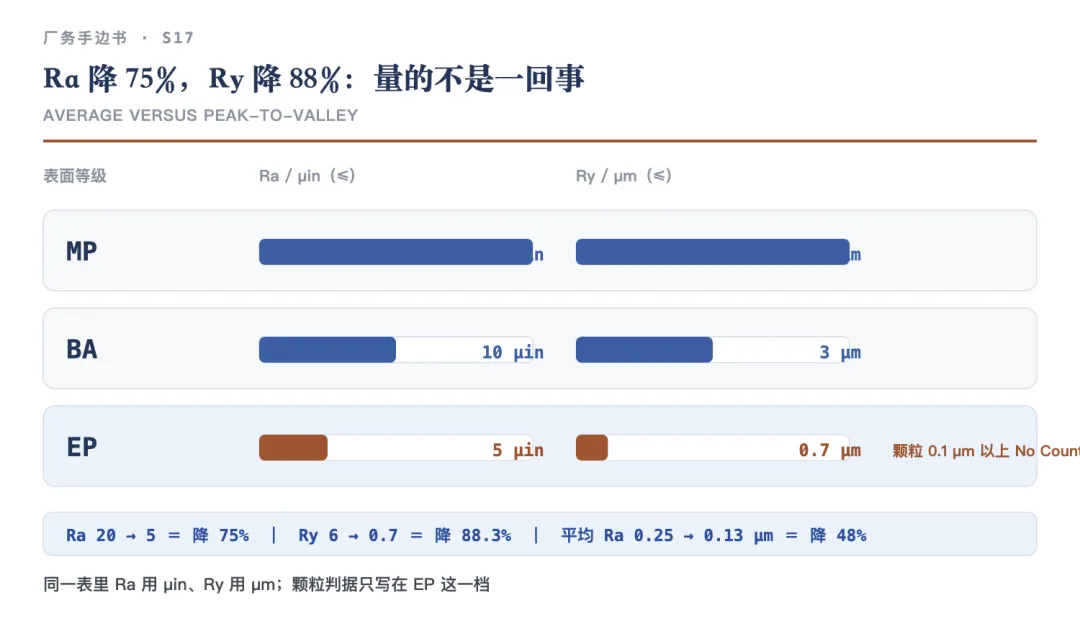
图 06 · MP 到 EP,Ra 降 75%、Ry 降 88.3%,颗粒判据只写在 EP 这一档
同一本表里,Ra 用 μin(微英寸),Ry 用 μm(微米);另两本的平均 Ra 用 μm,括号里附 μin。所以「0.25」和「20」看起来差很多,其实是不同单位下的不同量,不能并列相减,也不能说哪一档更光。本文判断:抄数时把单位连着数字一起抄,规格书里宁可写两行「Ra ≤5 μin」「Ry ≤0.7 μm」,也不要合并成一个数。册里没有做这两种写法的换算对照,别自行折算。
In one table Ra is in μin while Ry is in μm; in others average Ra is in μm with μin in brackets. "0.25" and "20" are different quantities in different units and cannot be subtracted or ranked. My inference: copy the unit with the number and keep two separate lines in a specification rather than merging them. No conversion table is printed, so do not derive one.
还有一层容易混:B.A. 与 High(E.P) 是表面等级代号,Class 10 是装配与包装的洁净等级,1 级洁净室是中册另一处写的清洗环境。三个「等级」说的是三件不同的事,样本把它们放在相邻段落,读的时候要按栏目归位。
A second confusion: B.A. and High(E.P) are surface grades, Class 10 is an assembly and packaging cleanliness class, and Class 1 is a cleanroom for final cleaning described elsewhere. Three "classes", three different things.
| 04 · A PARTICLE CRITERION ON ONE GRADE ONLY |
颗粒判据只写了一档
低压手动型那本在规格表里单独列了一行颗粒检查,写明「仅 EP」,对象是 0.1 μm 及以上颗粒,结果要求 No Count。也就是说,三档里只有最高那一档附带颗粒判据,另外两档只给了粗糙度数字。把「No Count」当成全系列承诺,是把括号里的限定读丢了。
One table adds a particle-inspection row explicitly marked "EP only": particles of 0.1 μm and larger, result No Count. Only the top grade carries a particle criterion; the other two give roughness figures alone. Reading No Count as a series-wide promise drops the qualifier.
本文判断:如果规格书需要颗粒判据,就得把表面等级一并写死到带该判据的那一档,否则验收时无据可依。册里没有说另外两档颗粒表现如何,所以也不该反过来推断它们「不合格」——只能说册里没写。
My inference: if a specification needs a particle criterion, the surface grade must be pinned to the one that carries it, or acceptance has no basis. The datasheets are silent on particles for the other grades, which is not the same as saying those grades fail.
带走 · 两句话
· Ra 与 Ry 降幅不同(75% 对 88.3%),因为一个看平均、一个看峰谷;册里没给定义,属本文判断。
· μin 与 μm 在同一张表里混用,别并列相减;颗粒判据 No Count 只写在 EP 那一档。
SUMMARY · IN ENGLISH
Ra falls 75% while Ry falls 88.3% across the same three grades — different quantities, a general metrology inference rather than a datasheet definition. μin and μm are mixed within one table, so keep units attached. The No Count particle criterion is printed for the EP grade only.
以上数据逐条回查过原页,判断部分已在文中标明;册里没写的,不写成结论。
李工手记 · 厂务手边书 · 内容仅个人观点,数据以手册原页为准
KEYWORDS
#粗糙度#Ra#Ry#BA#EP#电解抛光#颗粒检查#洁净等级#μin